
Houston is often described through its scale, but it reveals itself through detail. Neighborhood bars, understated restaurants and expansive green spaces shape a city that unfolds slowly — best explored through movement, short distances and everyday encounters.
Rather than focusing on landmarks, this overview follows how Houston is navigated: where to walk, pause, eat, and move across different parts of the city.
- Neighborhoods & Movement
- Parks
- Museums
- Sports & Stadiums
- Restaurants
- Bars
- Time-based Events
Neighborhoods & Movement
Neighborhoods
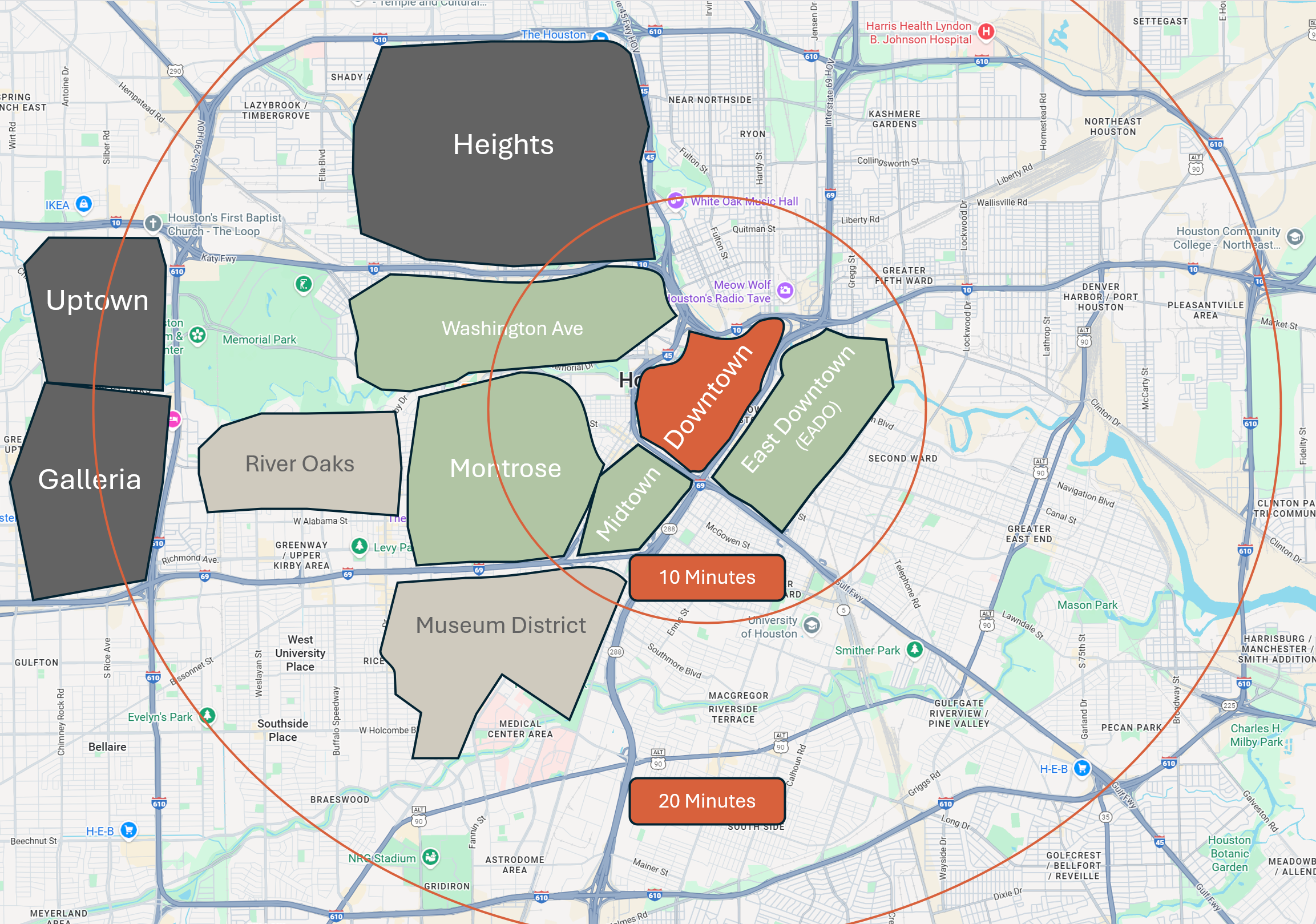
This is not a complete or fully accurate representation of Houston’s neighborhoods.
The map is meant as a rough orientation — a way to understand relative location and distance rather than precise boundaries.
Downtown is used as a reference point.
All distances are approximate and based on travel by car.
The map replaces exact addresses for the places mentioned below.
Use your preferred navigation app to find specific locations when needed.
Moving through the city
Houston is spread out.
Getting from one part of the city to another usually involves covering longer distances, and movement often defines how the city is experienced.
There are several ways to get around. Most people rely on ride-sharing services, while public transport and slower options work best in specific areas.
| Metro & Bus | Houston has a public transit system that connects key parts of the city. It works for certain routes and destinations, but is rarely the fastest option. For routes and coverage, see the METRO Interactive System Map | Bus and Rail Transit | Houston, Texas |
| Uber & Lyft | The most common and practical way to move around the city. Ride-sharing is widely used and often the easiest option for getting between neighborhoods. |
| Bicycle | There are some dedicated bike lanes and trails, though the network is limited. Cycling works well in certain neighborhoods, but less so across longer distances. |
| On foot | Houston is not a walkable city in a traditional sense. Still, walking can be rewarding within individual neighborhoods, where daily life unfolds at a slower pace. |
Parks & Green Spaces
Houston is expansive, and green spaces often feel like intentional pauses within the city.
Some parks are woven into daily urban life, others sit further out and offer a more immersive experience in nature.
| Discovery Green | A compact urban park in downtown Houston. Easy to reach and closely connected to the surrounding cityscape, it function as a short break rather than a destination. |
| Buffalo Bayou Park | Stretching between downtown and Midtown, this park follows the bayou and offers long paths for walking and cycling. It feels transitional — neither fully urban nor fully removed. |
| Memorial Park | One of the largest parks in the city, located between Washington Avenue and Uptown. Open, spacious, and heavily used by locals for running, walking, and outdoor routines. |
| Brazos Bend State Park | Located outside the city, this park offers a very different experience. Wildlife is part of the landscape, and alligators can sometimes be seen near the water. Sightings are not guaranteed, but the sense of distance from the city is (around 50 minutes away from downtown). |
Museums
Houston’s museums are largely concentrated in a few areas and work well as focused stops rather than full-day destinations.
The selection below reflects places that are easy to integrate into a broader day in the city. There are many more museums beyond this list.
| NASA Space Center | “Houston, we have a problem” — Located outside the city, the Space Center reflects Houston’s long-standing connection to space exploration. Visiting it requires planning and time, but it remains a defining reference point. |
| Museum of Natural Science | A large, accessible museum covering a wide range of topics. It works well as a straightforward, central option within the museum district. |
| Museum of Illusions | A smaller, more playful space focused on perception and visual effects. Best approached as a short visit rather than a traditional museum experience. |
| Museum of fine arts | One of the city’s core cultural institutions, spread across multiple buildings. Its scale allows for both brief visits and longer stays. |
| Artechouse | A digital and immersive exhibition space with a strong focus on light, sound, and technology-driven installations. |
| San Jacinto Monument | A historical monument rather than a museum, focused on scale, context, and memory. Rising to over 567 feet, it is recognized as the tallest monumental column in the world, standing slightly higher than the Washington Monument in Washington, D.C. |
Sports & Stadiums
Professional sports play a visible role in Houston’s public life.
Most major venues are concentrated around downtown or connected by simple transit routes, making games easy to integrate into a stay in the city.
| Houston Astros (Baseball) | Daikin Park | Located in downtown, the ballpark is embedded directly into the city. Game days are lively, but the area remains accessible even outside of events. |
| Houston Texans (American Football) | NRG Stadium | Situated south of downtown in the Astrodome Area, the stadium sits within a larger sports complex. It is easily reachable by public transport, especially on game days. |
| Houston Dynamo FC (Soccer) | Shell Energy Stadium | Located east of downtown, the stadium is within walking distance from central areas and blends well into the surrounding neighborhoods. |
| Houston Rockets (Basketball) | Toyota Center | Right in downtown, the arena is closely connected to restaurants and bars nearby. Games fit naturally into an evening in the city. |
Restaurants
Houston’s food scene is shaped by scale and diversity.
Rather than a single culinary identity, the city offers a wide range of cuisines spread across different neighborhoods.
The places listed below are not meant as a complete overview, but as points of reference that reflect how food is experienced across the city.
Texas Traditional Cuisine
This selection focuses on places connected to regional traditions and everyday food culture in Texas.
| Ninfas on Navigation & El Tiempo Cantina | Tex-Mex | Located in East Downtown, these places are closely tied to Houston’s Tex-Mex tradition and reflect a long-standing local food culture. |
| Taste of Texas | Texas-style steakhouse | Situated outside the city center, this restaurant represents a classic steakhouse experience associated with Texas dining. |
| The Pit Room & Pinkertons | Texas barbecue | Both locations are known for traditional barbecue and are spread across Montrose and the Heights. |
| Gu’s World Famous Fried Chicken | Fried Chicken | Located near Washington Avenue, this spot reflects a Southern-style approach to comfort food that fits naturally into the local context. |
International Cuisines
Houston’s international restaurants are less about novelty and more about everyday presence.
Many cuisines are represented in ways that feel established rather than imported.
| Musaafer | Michelin Star indian cousine | Located in the Galleria area, this restaurant focuses on regional Indian dishes presented in a contemporary setting. |
| Fogo de Chao | Brazilian steakhouse | A large-format dining experience centered around traditional Brazilian service and shared meals. |
| The Gipsy Poet | Pizza | Located in Midtown, this place focuses on simple, wood-fired pizza and a relaxed atmosphere. |
| Annabelles Brasserie | French cousine | Situated in Montrose, the restaurant reflects a European-style brasserie approach adapted to the local scene. |
Bars
Bars in Houston are less about a single nightlife district and more about atmosphere, setting, and movement.
Different types of bars are spread across neighborhoods, each shaping evenings in distinct ways.
High-Rise Bars
Bars with a view tend to cluster around downtown or sit just outside it.
Some are integrated into high-rise buildings, others offer distance and perspective rather than height.
| Z on 23rd | Downtown | A rooftop bar set high above the city, offering a direct view over downtown and the surrounding skyline. |
| Strato 550 | Downtown | Located in a high-rise setting, this bar focuses on elevation and interior atmosphere rather than an open rooftop. |
| Post Houston | Downtown | Part of a larger mixed-use space, with elevated outdoor areas that look across the city rather than down into it. |
| 77 Degrees | Midtown | Not elevated itself, but positioned to frame downtown from a distance. Works as an outside-in view rather than a skyline overlook. |
Sports & Rustic Bars
These places are less about views and more about atmosphere.
They are tied to game days, live events, and casual evenings rather than specific locations or occasions.
| The Rustic | Multiple locations, including downtown | A hybrid of bar, music venue, and open space, often shaped by live performances and larger crowds. |
| Truck Yard | East Downtown (EaDo) | An informal outdoor bar with a flexible setup, food trucks, and a relaxed, social atmosphere. |
| Pitch 25 | EaDo | Focused on sports and large screens, with indoor and outdoor areas that work well during matches and events. |
Western Music and Dance (Country Clubs)
These venues reflect a more traditional side of Houston’s nightlife.
They combine live country music, dance floors, and a social atmosphere that is less about performance and more about participation.
| Goode Company | Montrose | A long-established venue where food, music, and casual dancing come together in a relaxed setting. |
| Cattlemen’s Country Club | A classic country club focused on line dancing and live music, drawing a mix of regulars and visitors curious about the local scene. | |
| Rowdy’s Dance Hall | A larger dance hall where country music and group dancing shape the evening more than the bar itself. | |
Beer Gardens
Beer gardens in Houston tend to function as social meeting points rather than destination bars.
They are informal, open, and often connected to neighborhood routines rather than nightlife districts.
| Bayou Heights Bier Garten | A spacious outdoor beer garden with a relaxed, communal atmosphere. |
| Heights Bier Garten | Located in the Heights, this place blends neighborhood life with an open-air setup suitable for longer, unstructured evenings. |
| King’s Bierhaus | A German-style beer hall combining traditional food, beer, and a lively but informal setting |
On Main Street in Downtown
Bars along Main Street work through proximity rather than destination. Evenings here unfold by moving short distances on foot.
| SoHo Garden | An open bar space integrated directly into the street, combining indoor and outdoor areas. |
| Notsuoh | An eclectic, visually layered space with an intentionally undefined atmosphere. |
High-Class Bars and Clubs
These venues follow a more curated approach, where setting and pacing shape the evening.
| Koya | A venue combining dining, performance, and nightlife within a controlled setting. |
| Sante | A refined bar environment with a quieter, composed social rhythm. |
| Melrose | A club-oriented space where music and crowd energy dominate. |
| Tago | A late-evening venue centered around DJ-driven movement. |
Design-Focused Bars
Here, spatial concept and visual identity take precedence over function.
| Rosewells Saloon | A bar defined by retro references and dramatic interior design. |
| Betlegeuse Betlegeuse | Bold colors and unconventional layout define the space. |
| Notsuoh | Appearing again in a different context, the bar’s layered interior and shifting spaces place it as much within design as within nightlife. |
| Wonder Bar | A compact bar where lighting and layout create a distinctly enclosed atmosphere. |
Time-based Events
Some aspects of the city are shaped less by place and more by time.
Certain events return every year and briefly change how Houston feels, moves, and presents itself.
General Events
| Mardi Gras Galveston | February | While Houston itself remains relatively calm, Galveston — about an hour away — hosts one of the largest Mardi Gras celebrations in the region, second only to New Orleans. |
| Houston Livestock Show and Rodeo | March | A large-scale annual event combining rodeo competitions, concerts, and exhibitions. It temporarily becomes one of the city’s central reference points. |
| Lagoonfest Texas | Late spring to early fall | A seasonal outdoor venue centered around water, leisure, and warm-weather routines rather than fixed dates. |
| Halloween at Wonder Bar | October | Seasonal decorations and themed evenings appear across the city. Some bars, including Wonder Bar, become temporary focal points during this period. |
| Christmas in Houston | December | During the winter season, decorations appear across different neighborhoods. River Oaks, downtown displays, and seasonal installations shape the city without concentrating activity in a single location. |
| Parades in Downtown | Throughout the year | Various public holidays and cultural occasions are marked by parades that briefly shift movement patterns in the downtown area. |
Houston reveals itself less through landmarks and more through movement, distance, and everyday routines.
The city does not ask to be consumed quickly, but to be navigated gradually — by car, by neighborhood, and by time.
What remains are not highlights, but a sense of scale, rhythm, and the spaces in between.
First time in Houston?
 Heino Rätscher